If you’re still walking past the frozen section of the store phyllo dough, it’s time to take courage. This paper-thin dough looks fragile and whimsical to many, but it’s really easy to make.
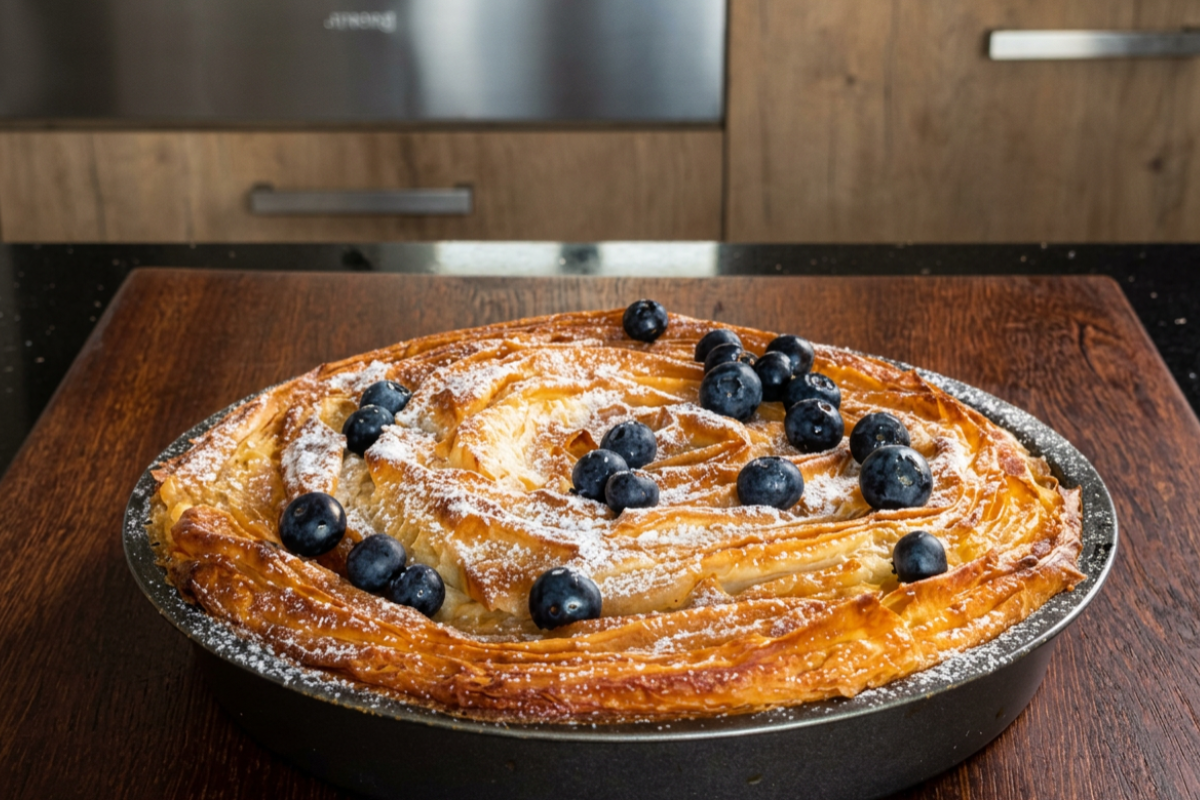
This traditional Greek cake, known in Greece as Soufra (the word means pleated, ruffled fabric) requires just a few ingredients. The cooking technique itself – folding the dough sheets into an “accordion” and rolling them into a rose – creates a wonderful texture that is crispy on the outside and creamy on the inside. and it looks beautiful, as if you spent half a day in the kitchen!
What will you need for this cake?
- Filo Dough: 1 packet (defrosted)
- Butter: 1/2 packet (about 90-100g, thawed)
- Berries: a couple of handfuls of fresh cherries, cherries or blueberries
- For the egg-cream topping:
- 3 eggs
- 100 g of sugar
- 200 ml whipping cream (35-36%)
- 100 ml of milk
- Grated peel of 1 lemon (will give an unreal Greek aroma)
- 1 teaspoon a teaspoon of vanilla extract
An important secret before you start: Take the filo dough out of the freezer in advance. It is very important to leave it on the counter before taking it out of the package so that it completely warms up to room temperature. Cold dough will be brittle and crackly, and warmed up – elastic and obedient.
Cooking process: step by step
- Preparation: Preheat the oven to 180°C. Melt half a packet of butter in a small saucepan. Lightly grease a baking dish (a round one with a diameter of about 26-28 cm is best).
- Pleating (Soufra technique): Take one sheet of phyllo dough (cover the others with a slightly damp towel to prevent them from drying out). With a brush (or just your hands), lightly brush it with melted butter and grease it. With the short edge, pinch the sheet into an “accordion” with your fingers. Loosely roll the resulting strip into a rose and place it in the center of the baking dish. Prepare the other leaves in the same way and wrap them around the central rose until you have filled the entire shape. If necessary, make larger gaps to fill the form.
- First baking: Brush the top of the cake with the remaining melted butter. Place in the oven for about 15-20 minutes, until the edges of the pastry are nicely browned and crispy.
- Preparation of the filling: While the dough is baking, beat eggs with sugar in a bowl, mix in cream, milk, vanilla and grated lemon peel.
- Final baking: Remove the browned cake from the oven. Put the berries in the gaps of the dough (if you use cherries, remove the pits). Pour the prepared egg batter mixture evenly over everything. Return to the oven for a further 30-35 minutes until the topping is fully set and the top is a nice golden colour.
To me, this cake tastes best while it’s still slightly warm, and when it’s baked it smells amazingly lemony and summery. You can additionally sprinkle with powdered sugar before serving.
Idea for the future (non-sweet version)
A similar Soufra principle can be used to prepare wonderful unsweetened cakes! Instead of sweet whipped dough, the folds of dough can be filled with feta cheese, cottage cheese, spinach or other cheeses. This idea is already on my list of upcoming recipes, so I will definitely share!
Soufra is a Greek filo pastry
Ingredients
- 1 packet Filo pastry (thawed)
- 1/2 packet Butter (about 90-100 g, dissolved)
- Berries: a couple of handfuls of fresh cherries, cherries or blueberries
- 3 eggs
- 100 g sugar
- 200 ml whipping cream (35-36%)
- 100 ml milk
- 1 grated lemon peel (will give an unreal Greek aroma)
- 1 tsp vanilla extract
Instructions
- Preparation: Preheat the oven to 180 °C. Melt half a packet of butter in a small saucepan. Lightly grease a baking dish (a round one with a diameter of about 26-28 cm is best).
- Folding (Soufra technique): Take one sheet of phyllo dough (cover the others with a slightly damp towel to prevent them from drying out). With a brush (or just your hands), lightly brush it with melted butter and grease it. With the short edge, pinch the sheet into an “accordion” with your fingers. Loosely roll the resulting strip into a rose and place it in the center of the baking dish. Prepare the other leaves in the same way and wrap them around the central rose until you have filled the entire shape. If necessary, make larger gaps to fill the form.
- First baking: Brush the top of the cake with the remaining melted butter. Place in the oven for about 15-20 minutes, until the edges of the pastry are nicely browned and crispy.
- Preparation of the topping: While the dough is baking, beat eggs with sugar in a bowl, mix in cream, milk, vanilla and grated lemon peel.
- Final baking: Take the cake out of the oven when it is just golden brown. Put the berries in the gaps of the dough (if you use cherries, remove the pits). Pour the prepared egg batter mixture evenly over everything. Return to the oven for a further 30-35 minutes until the topping is fully set and the top is a nice golden colour.
- To me, this cake tastes best while it’s still slightly warm, and when it’s baked it smells amazingly lemony and summery. You can additionally sprinkle with powdered sugar before serving.