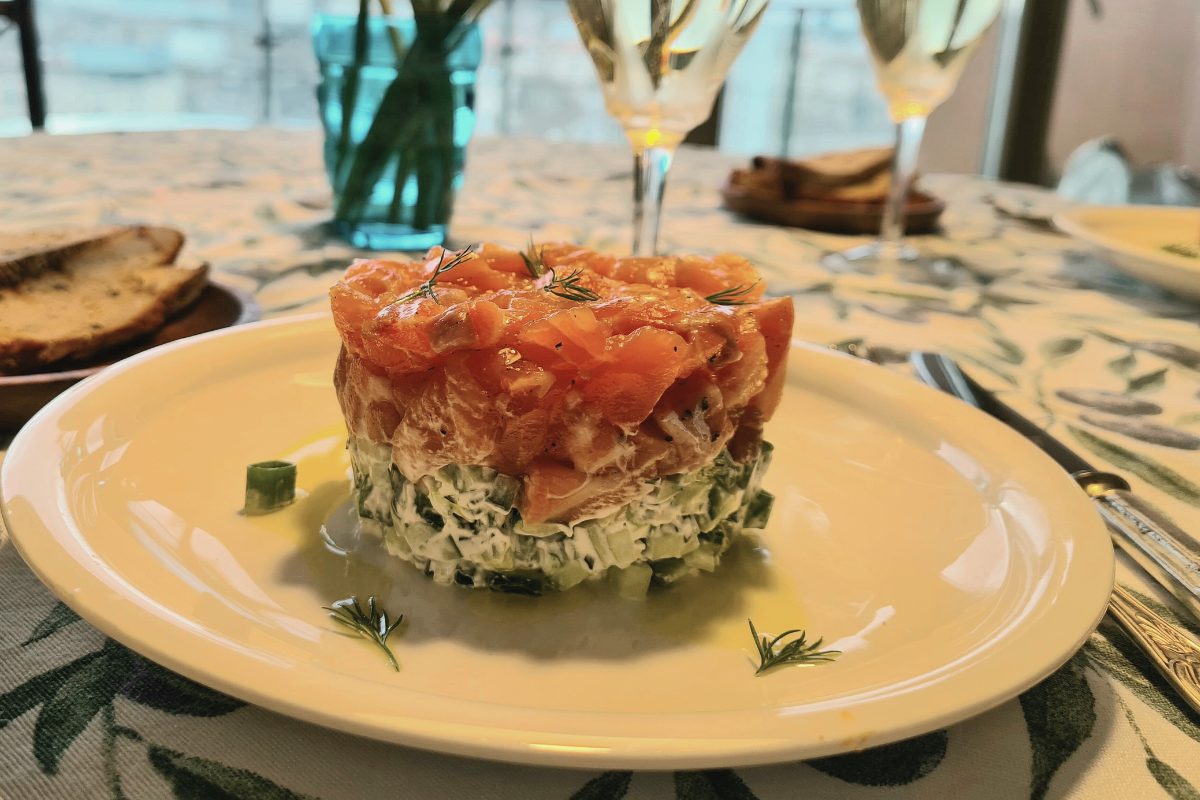
Salmon tartare could be the very first tartare, even for those who are skeptical about eating uncooked fish or meat. If you don’t mind sushi, this tartare will taste very similar, but without the rice and maki leaves. Tartars with two layers are tastier to me, so I am describing even two versions here. Salmon tartare with avocado and salmon tartare with cucumber and Philadelphia cheese. If the first is more tartaric, because it is prepared with avocado tuna and beef tartare, it is cucumber – Philadelphia cheese, completely similar to the popular Philadelphia sushi.
By the way, salmon is the most popular fish in Lithuania, the promotions of which attract crowds to stores. I know from experience! Quite often, good price promotions are for a whole big fish, and then you have to think about what to make of it. I suggest cooking the fish from the head and tail broth. Someday, later you can make it with the broth chowder, thick bleached fish fillets, or boullabaise, Provençal fish and seafood soup – stew. Then cut a few slices and bake them. Definitely get salty, to have for salmon sandwiches. But first, make a salmon tartare from a fresh piece.
Ingredients
Salmon layer
- 300 g of fresh salmon
- 0.5 pcs finely chopped spring onion
- 1 pc a small, gherkin pickle Or a spoonful of pickled capers
- 0.5 pcs lemon zest from half a lemon
- 1 tablespoon of lemon juice
- Salt and black pepper to taste
Avocado layer
- 1 pc A large, ripe avocado
- 1 spoonful of chopped scallions (can be without onions)
- Salt, pepper
Cucumber and Philadelphia cheese layer
- 1 pc fresh cucumber
- 200 g of Philadelphia-style spreadable cheese without any additives
- Fresh dill
- A little salt if you need it saltier
Manufacturing
Preparation of salmon
- Cut the salmon into small cubes.
- In a bowl with salmon, add finely chopped shallots, gherkins (or capers), grate lemon peel, squeeze lemon juice and mix well, add salt and pepper to taste
- Leave it cold for at least 10 minutes to allow the flavors to combine and the fish to marinate easily.
- While the tartare is marinating, prepare the bottom layer of avocado or cucumber.
Avocado (option A)
- Cut the avocado in half.
- With the sharp edge of the knife (like an axe), lightly cut into the pit of the avocado and turn the knife to remove the pit easily.
- Hold the avocado half with the peel in a handful, and use a knife to score the flesh as if slicing. Try to press the knife just enough to reach the peel.
- Scoop out the avocado with a spoon. If the avocado is large, dig in half. This will give you a nicely diced avocado.
- Add the scallions. Season with salt and pepper, mix lightly but do not mash.
- Cook the avocado just before serving.
Cucumber with Philadelphia cheese (option B)
- Peel the fresh cucumber, scoop out the seeds and cut into small cubes.
- Mix with Philadephia cheese and finely chopped dill.
- Taste and if it lacks saltiness, add salt.
Tartarus
- On a plate, using a culinary ring, place a single layer of avocado or cucumber and top with beef. Garnish with dill, sprinkle with quality extra virgin olive oil, season with salt crystals.
It remains to be tasted, delicious!
Salmon tartar with avocado
Ingredients
- 300 g fresh salmon
- 0,5 finely chopped spring onion
- 1 a small gherkin pickle Or a spoonful of pickled capers
- 0,5 lemon zest from half a lemon
- 1 tbsp lemon juice
- Salt and black pepper to taste
- 1 A large, ripe avocado
- 1 tsp chopped spring onions (may be without onions)
- Salt, pepper
- Dill and olive oil for serving
Instructions
Salmon
- Cut the salmon into small cubes.
- In a bowl with salmon, add finely chopped shallots, gherkins (or capers), grate lemon peel, squeeze lemon juice and mix well, add salt and pepper to taste
- Leave it cold for at least 10 minutes to allow the flavors to combine and the fish to marinate easily.
Avocado
- Cut the avocado in half.
- With the sharp edge of the knife (like an axe), lightly cut into the pit of the avocado and turn the knife to remove the pit easily.
- Hold the avocado half with the peel in a handful, and use a knife to score the flesh as if slicing. Try to press the knife just enough to reach the peel.
- Scoop out the avocado with a spoon. If the avocado is large, dig in half. This will give you a nicely diced avocado.
- Add the scallions. Season with salt and pepper, mix lightly but do not mash.
- Cook the avocado just before serving.
Serving
- Using a culinary ring, place a layer of avocados on top of the salmon. Garnish with dill, sprinkle with olive oil and season with salt crystals.
Salmon tartare with cucumbers and cream cheese
Ingredients
- 300 g fresh salmon
- 0,5 finely chopped spring onion
- 1 a small gherkin pickle Or a spoonful of pickled capers
- 0,5 lemon zest from half a lemon
- 1 tbsp lemon juice
- Salt and black pepper to taste
- 1 fresh cucumber
- 200 g Philadelphia-style spreadable cheese without any additives
- Fresh dill
- A little salt if you need it saltier
- Olive oil for serving
Instructions
Salmon
- Cut the salmon into small cubes.
- In a bowl with salmon, add finely chopped shallots, gherkins (or capers), grate lemon peel, squeeze lemon juice and mix well, add salt and pepper to taste
- Leave it cold for at least 10 minutes to allow the flavors to combine and the fish to marinate easily.
Cucumber layer
- Peel the fresh cucumber, scoop out the seeds and cut into small cubes.
- Mix with Philadephia cheese and finely chopped dill.
- Taste and if it lacks saltiness, add salt.
Serving
- Using a culinary ring, place a layer of cucumber and cheese, then salmon on top. Garnish with dill, sprinkle with olive oil and season with salt crystals.