I envisioned this recipe a good fifteen or even more years ago, when the first bloggers started sharing recipes. The Uzbek Stalik, who even now has a YouTube channel and shares recipes from those countries, is indicated as the primary source.
For me personally, all of that kumbaya, that only men can make a good pilaf, and the like, is very, very strongly about the Far East and the Eastern mentality, but… when men at the farmstead fail to cook shurpa in a cauldron or make a pilaf from scratch, it is simply unreasonable to come to the rescue.
Here I will share how to make pilaf in the home kitchen with less drama and great results.
You will need mutton or lamb, large, firm carrots and pilaf rice. Uzbeks cook with special, very hard devzira rice. You can also find them in Lithuanian stores, just enter them in google search and they will show you which ones you have. There is also pilaf rice to buy. It is important that the rice is not starchy and does not boil quickly.
There are several important stages in the production of plov:
- first, prepare the rice: wash well and soak so that as little starch remains as possible, otherwise the pilaf will not be loose
- second, cook the base of the pilaf, zirvak – fatty lamb, onion and carrot stew
- third, cooking the rice: the rice must \”get fat\” and absorb the fatty zirvak broth
- the last – to give time for “rest”, i.e. after cooking, cover the pot and leave it for another twenty minutes so that the pilaf is fully cooked
Ingredients
- 1 kg of lamb – ham and 3-4 pieces with bones (if you don’t like lamb – lamb, you can replace it with beef or veal, but real pilaf is made from lamb),
- 300g lamb’s fat – you can use oil, preferably olive)
- 1 kg devzira rice – other medium-grain rice suitable for pilaf may be available, look for larger stores with a label Pilaf
- 1 kg carrots, preferably large, firm, almost “forage”
- 2-3 pcs. medium onions
- 2-3 pcs. heads of garlic, peel the outer hard skins but leave the heads intact, the garlic cloves should remain in their skins
- 1-3 hot peppers
- cumin, sea buckthorn berries, bay leaves, salt
Manufacturing
Zirvak
- First, cut the carrots, large, firm, and even dry ones are fine, but by no means tender, fresh juicy carrots, they will just boil Cut into long strips of 0.3 X 0.3 cm.
- Cut the ham into cubes of a couple of centimeters, sprinkle with a little salt and leave to marinate at room temperature.
- Prepare the rice. Rinse under running water until completely clean water runs out. Soak the rice in warm (but not hot) water.
- Heat the pot very well. Uzbeks make pilaf in a boiler, on firewood, and I make it at home, on an electric stove. Instead of a cauldron, a heavy, sizzling, danish pot, or other heavy, well-heated vessel will do just fine.
- Add oil and heat well. If you are cooking with oil, put it in the bottom of the pot and leave it so that the oil explodes, giving away all the fat. Then scoop the crackers out of the pot.
- First, brown the meat in hot fat. When the meat is brown, scoop it out and set it aside.
- Then cook the onions. Stirring from time to time, wait until the onions become golden and all the water evaporates from them.
- Return the meat to the pot with the onions, wait until it heats up again.
- Place the carrots in an even layer on top of the meat and onions and leave to fry for two to three minutes
- Mix carefully, try not to mash the carrots. Fry for another 10 minutes on high heat, after ten minutes reduce the heat to medium, add some cumin, add bay leaves, sea buckthorn berries if you want a more sour taste. You can add saffron, but very little.
- Pour boiling water to cover everything by 1-1.5 cm.
- Add the garlic heads, they should be healthy with only the hard outer skins removed. If you are cooking with dried hot peppers, add them now, fresh ones can be added later.
- When the mass boils, reduce the heat to very low and leave to simmer for another forty minutes, no less.
- Add a little more salt. The rice will pick up some of the salt later.
- Zirvakas, the basis of the pilaf is ready! If you want, you can save part of it for another time, even freeze it. Then, you just have to warm it up, boil it and finish cooking the pilaf with rice.
Plov
- Pour well-washed and soaked rice into the boiling zirvak. We spread them evenly on the surface of the zirvak.
- Carefully, so that the rice does not mix, we pour about 1 liter of boiling water, so that the surface of the rice is covered by 1-1.5 cm.
- We turn up the heat as much as possible so that the whole mass boils as quickly as possible, the zirvak fat bubbles up and rises above the rice. This step is very important, otherwise the rice will not be loose.
- When the pot boils, reduce the heat to medium and cook until the rice is almost done and there is almost no liquid left in the pot. Do not mix anything!
- If the rice is still hard and the liquid has already evaporated, add a little water over the edge of the pot, it’s better to add less a few times than to multiply.
- If the rice is almost cooked and there is still way too much liquid, carefully make a few holes all the way to the bottom and turn up the heat to allow the excess liquid to evaporate more quickly through those tunnels.
- When the liquid is gone and the rice is almost ready, turn off the heat, season the rice with cumin and leave the pot covered for 20 minutes. During this time, the rice will absorb all the remaining moisture and cook.
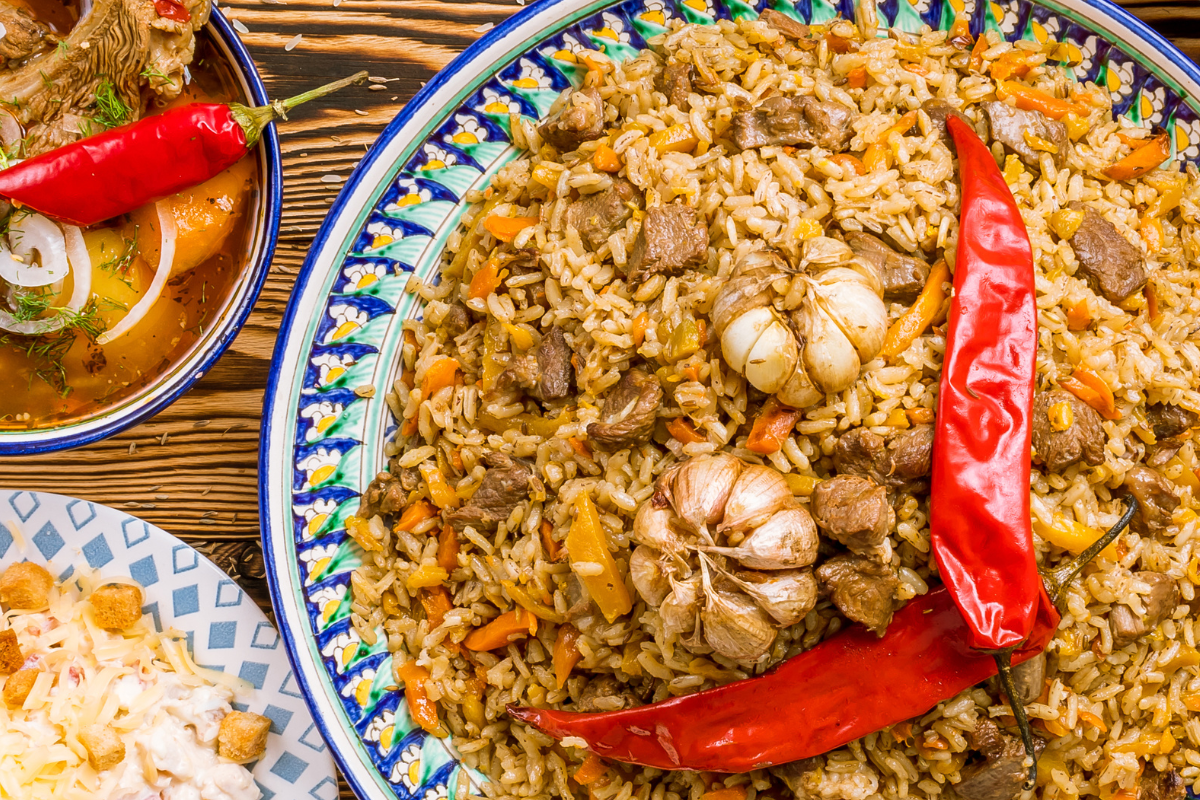
A good pilaf should be loose, the rice should not stick and be wet.
Mix the pilaf carefully before serving. Scoop out the garlic and hot pepper. You can transfer the dish to a large container, put the garlic on top. Each eater will be able to enjoy his portion with pressed garlic. That garlic is divine to me! It is worth making pilaf just for its sake
Uzbeks eat pilaf with their hands or a spoon. But this is everyone’s personal matter
A good pilaf should be loose, the rice should not stick and be wet.
Mix the pilaf carefully before serving. Scoop out the garlic and hot pepper. You can transfer the dish to a large container, put the garlic on top. Each eater will be able to enjoy his portion with pressed garlic. That garlic is divine to me! It’s worth making pilaf just because of it 🙂
Uzbeks eat pilaf with their hands or a spoon. But that’s everyone’s personal matter 🙂
Plov with lamb
Ingredients
- 1 kg lamb – ham and 3-4 pieces with bones (if you don’t like lamb – lamb, you can replace it with beef or veal, but the real pilaf is made from lamb),
- 300 g lamb fat – you can use oil, preferably olive)
- 1 kg devzira rice – there may be other medium grain rice suitable for pilaf, look for pilav in larger stores
- 1 kg carrots, preferably large, firm, almost “forage”
- 2-3 medium onions
- 2-3 heads of garlic, peel the outer hard skins but leave the heads intact, the garlic cloves should remain in their skins
- 1-3 hot pepper
- cumin, sea buckthorn berries, bay leaves, salt
Instructions
Zirvak
- First, cut the carrots, large, firm, and even dry ones are fine, but by no means tender, fresh juicy carrots, they will simply boil Cut into long strips of 0.3 X 0.3 cm.
- Cut the ham into cubes of a couple of centimeters, sprinkle with a little salt and leave to marinate at room temperature.
- Prepare the rice. Rinse under running water until completely clean water runs out. Soak the rice in warm (but not hot) water.
- Heat the pot very well. Uzbeks make pilaf in a boiler, on firewood, and I make it at home, on an electric stove. Instead of a cauldron, a heavy, sizzling, danish pot, or other heavy, well-heated vessel will do just fine.
- Add oil and heat well. If you are cooking with oil, put it in the bottom of the pot and leave it so that the oil explodes, giving away all the fat. Then scoop the crackers out of the pot.
- First, brown the meat in hot fat. When the meat is brown, scoop it out and set it aside.
- Then cook the onions. Stirring from time to time, wait until the onions become golden and all the water evaporates from them.
- Return the meat to the pot with the onions, wait until it heats up again.
- Place the carrots in an even layer on top of the meat and onions and leave to fry for two to three minutes
- Mix carefully, try not to mash the carrots. Fry for another 10 minutes on high heat, after ten minutes reduce the heat to medium, add some cumin, add bay leaves, sea buckthorn berries if you want a more sour taste. You can add saffron, but very little.
- Pour boiling water to cover everything by 1-1.5 cm.
- Add the garlic heads, they should be healthy with only the hard outer skins removed. If you are cooking with dried hot peppers, add them now, fresh ones can be added later.
- When the mass boils, reduce the heat to very low and leave to simmer for another forty minutes, no less.
- Add a little more salt. The rice will pick up some of the salt later.
- Zirvakas, the basis of the pilaf is ready! If you want, you can save part of it for another time, even freeze it. Then, you just have to warm it up, boil it and finish cooking the pilaf with rice.
Plov
- Pour well-washed and soaked rice into the boiling zirvak. We spread them evenly on the surface of the zirvak.
- Carefully, so that the rice does not mix, we pour about 1 liter of boiling water, so that the surface of the rice is covered by 1-1.5 cm.
- We turn up the heat as much as possible so that the whole mass boils as quickly as possible, the zirvak fat bubbles up and rises above the rice. This step is very important, otherwise the rice will not be loose.
- When the pot boils, reduce the heat to medium and cook until the rice is almost done and there is almost no liquid left in the pot. Do not mix anything!
- If the rice is still hard and the liquid has already evaporated, add a little water over the edge of the pot, it’s better to add less a few times than to multiply.
- If the rice is almost cooked and there is still way too much liquid, carefully make a few holes all the way to the bottom and turn up the heat to allow the excess liquid to evaporate more quickly through those tunnels.
- When the liquid is gone and the rice is almost ready, turn off the heat, season the rice with cumin and leave the pot covered for 20 minutes. During this time, the rice will absorb all the remaining moisture and cook.
- Mix the pilaf carefully before serving. Scoop out the garlic and hot pepper. You can transfer the dish to a large container, put the garlic on top. Each eater will be able to enjoy his portion with pressed garlic. That garlic is divine to me! It is worth making pilaf just for its sake