
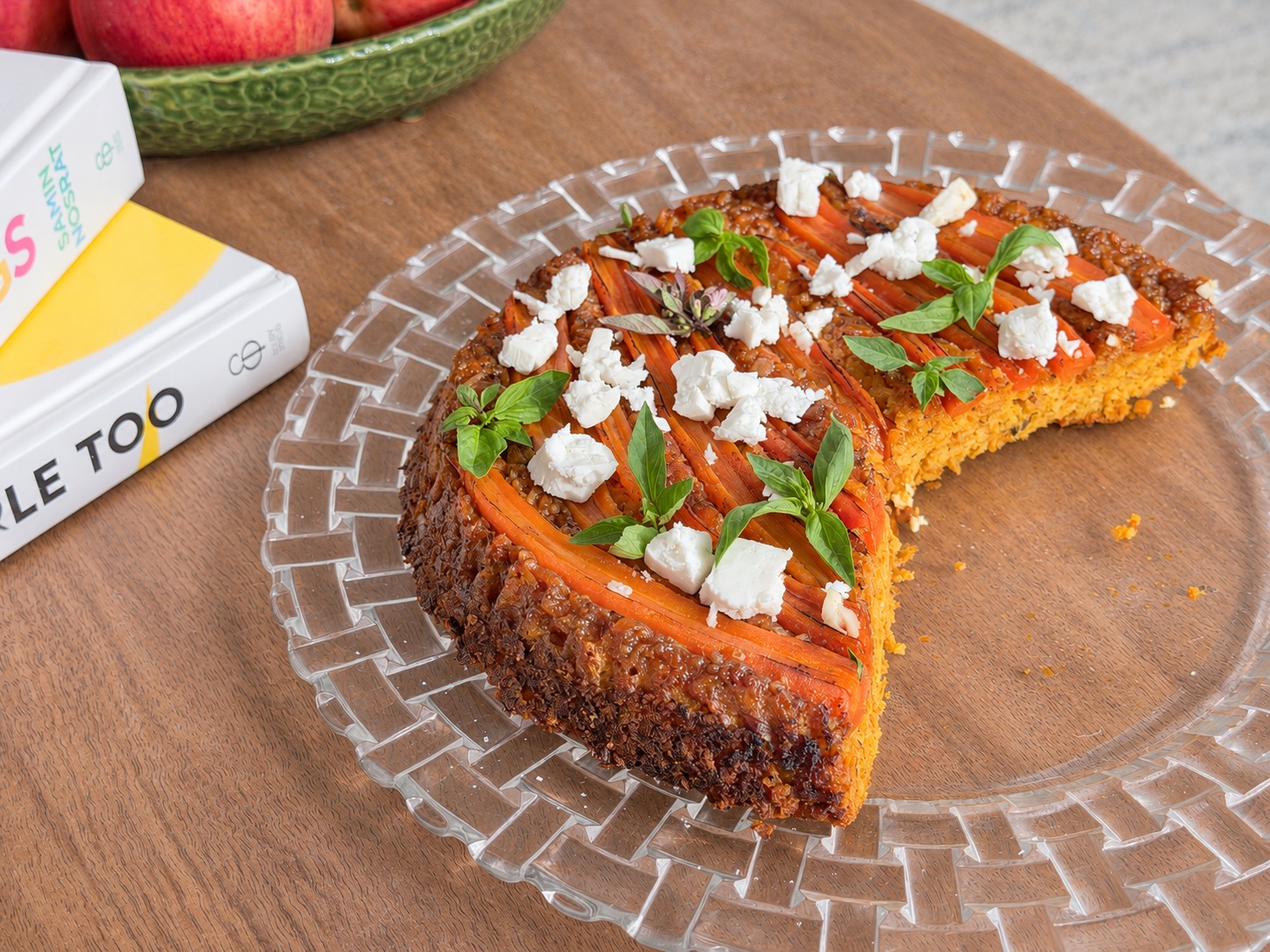
This time, I was expecting some very special guests: the team from Stilius, the much-loved Lithuanian television programme on LRT, were coming to interview me! I had no idea what to serve them, and of course I wanted to make a good impression. I baked a carrot cake, only this time it was savoury, with onions, cumin, coriander seeds and cheese. On top, carrot halves caramelised with a spoonful of honey and balsamic vinegar, finished with crumbled feta and fresh herbs. It turned out rather lovely!
I spotted the idea on the mellieskichen account. I did not have an exact recipe, and I did not weigh everything precisely when I made it. But understanding the method matters more here. The quantities below are a guide, and I will explain what to pay attention to as you cook.
The tarte Tatin idea
The simplest way to explain it is this: I arrange what will become the topping in the bottom of the tin, spoon the carrot mixture over it, bake, then turn it out.
Now for each step in a little more detail.
I start by peeling small, neat carrots, halving them lengthways, drizzling them with olive oil and roasting them in the air fryer. You can also use the oven; the carrots will just take a little longer. Before roasting, check how many you need to cover the base of your tin. Carrots vary so much in size that a weight alone is not very helpful here.
I cut a circle of baking paper to fit the base of the tin, then add a spoonful of honey and the balsamic vinegar straight onto it. I mix and spread them to cover the base. The partly roasted carrots go on top, cut-side down against the base. Pack them closely together: they will shrink a little more as they bake, and a tightly packed topping makes the cake look all the lovelier when you turn it out.
Give the carrots and onions time
I briefly warm crushed coriander seeds, cumin and black pepper in a frying pan, then add extra virgin olive oil and finely chopped onions. A little salt, low heat and an occasional stir, until the onions soften.
You can cover the onions, turn the heat down and let them cook slowly for as long as half an hour while you prepare the carrots. Just remember they are still on the hob, and give them an occasional stir. 🙂
Next come the coarsely grated carrots and a little more salt. This is the stage to take your time with. The carrots should be soft and the excess moisture should have evaporated. If you have ever made the soft carrot-and-onion topping for Lithuanian herring, that is the texture to aim for. 🙂
I let the mixture cool slightly, then add a generous handful of grated cheese. Cheddar or another cheese that melts well works here; I used a pizza cheese blend. Next come four eggs and two tablespoons of dry fine couscous. Semolina works as an alternative. I mix everything together, spread it over the carrot halves in the tin and bake at 180°C for about 40–45 minutes, until the cake is set and cooked through in the centre.
Turn out and finish
Once the cake has cooled slightly, I loosen the edges and carefully turn it out onto a plate. Peel away the baking paper, crumble over the feta and add fresh herbs. I love how basil looks on top.
The quantities below are a guide for a 20–22 cm tin. Think of this as a method you can work with: carrots vary in size and moisture, so pay attention to the pan. Get the vegetables soft and let the excess moisture cook away before adding the eggs and cheese.
All that is left is to cut a slice. Enjoy!
Upside-Down Savoury Carrot Cake
Ingredients
- 6–9 small, slender carrots or enough to closely cover the base of the tin
- 1 tbsp honey
- 1 tbsp balsamic vinegar
- 1 tbsp olive oil for roasting the carrot halves
- 350–400 g coarsely grated carrots about 3–4 larger carrots
- 1 large onion or 2 medium onions
- 4 eggs
- 80–100 g grated cheese Cheddar, a pizza cheese blend or another cheese that melts well
- 2 tbsp dry fine couscous or semolina
- 2 tbsp extra virgin olive oil EVOO
- ½ tsp crushed coriander seeds
- ½ tsp cumin
- freshly crushed black pepper
- salt to taste
- 50–70 g feta
- fresh herbs basil, thyme or your favourites
Instructions
- Peel the small carrots and halve them lengthways. Before roasting, check how many halves you need to closely cover the base of the tin and prepare enough in one go. Toss with 1 tbsp olive oil. Roast in an air fryer until slightly softened and beginning to brown. As a guide, use 180°C for about 10–15 minutes, depending on the thickness of the carrots. You can also roast them in the oven until slightly softened and beginning to brown; this will take longer.
- Finely chop the onions. Briefly warm the crushed coriander seeds, cumin and black pepper in a frying pan. Add 2 tbsp extra virgin olive oil and the onions. Season with salt and cook over a low heat, stirring occasionally, until softened.
- Add the 350–400 g coarsely grated carrots and a little more salt. Continue cooking, stirring, until the carrots are soft and excess moisture has evaporated. Aim for a soft carrot-and-onion mixture, like the cooked vegetable topping served with Lithuanian herring. Remove from the heat and let cool slightly.
- Preheat the oven to 180°C. Cut a circle of baking paper to fit the base of a 20–22 cm baking tin and place it inside. Add 1 tbsp honey and 1 tbsp balsamic vinegar to the paper, then mix and spread to cover the base, without heating them first. Pack the partly roasted carrot halves closely together, with their cut sides against the base: they will shrink further as they bake.
- Stir the 4 eggs, 80–100 g grated cheese and 2 tbsp dry fine couscous or semolina into the slightly cooled carrot-and-onion mixture. Spread evenly over the carrot halves in the tin and level the surface.
- Bake at 180°C for about 40–45 minutes, until set and cooked through in the centre.
- Let cool slightly. Loosen the edges, place a serving plate over the tin and carefully turn the cake out. Remove the tin and baking paper. Crumble over 50–70 g feta, add fresh herbs and serve.
Equipment
- air fryer or oven, frying pan, coarse grater, 20–22 cm baking tin, baking paper and a plate for turning out

Those who tried the recipe say…
We’re waiting for the first approved cooking experiences for this recipe. Yours could be the first!